
|
Level 0
How to teach initial sounds or beginning sounds This is the first stage in learning to read and the most essential one This page contains affiliate links |
How we teach initial sounds
We follow the order of the alphabet
Experience has taught us that the most practical way to teach the initial sounds is to follow the letter order of the alphabet. Some decry this, but in practice, between us, we have yet to meet a child of any ability for whom this has been a problem. We have found, instead, that it only has a positive effect as children like to track their progress through the alphabet and many learn to say the alphabet as they go. It seems to give the child a sense of order, and he/she can see his/her progress, which acts as an incentive to learn the letters and their sounds. Unlike many other phonics programmes, we do not attempt to teach children to blend these sounds until s/he reaches the sound 'u', when we begin oral blending. This ensures that the child can focus all their attention on learning to hear the initial sounds of words and being able to give a sound for a given letter and find the letter for a given sound, as well as learning to form the letters.
Some need more time, some need less, but flashcards help learners to progress at the fastest possible rate for the individual child.
You can either make your own, using, for example, old cereal boxes cut up, or you can print out ours from our FREE packs (see bottom of page).
The flashcards must be practised daily. Insufficient/erratic practice makes progress slow, and the child can lose interest.
All students then move through as fast as is possible for the individual.
I do not advise taking weeks to learn the letter sounds, or even turning it into a game. At this early stage, we are setting the scene for our tuition: short, but intensive. Keep your teaching sessions as simple as possible with the use of flashcards and a good ABC book. Teach with a sense of purpose and understand that we do not look for perfection from day 1. Trust the programme and move through, holding the aims (below) in mind.
Experience has taught us that the most practical way to teach the initial sounds is to follow the letter order of the alphabet. Some decry this, but in practice, between us, we have yet to meet a child of any ability for whom this has been a problem. We have found, instead, that it only has a positive effect as children like to track their progress through the alphabet and many learn to say the alphabet as they go. It seems to give the child a sense of order, and he/she can see his/her progress, which acts as an incentive to learn the letters and their sounds. Unlike many other phonics programmes, we do not attempt to teach children to blend these sounds until s/he reaches the sound 'u', when we begin oral blending. This ensures that the child can focus all their attention on learning to hear the initial sounds of words and being able to give a sound for a given letter and find the letter for a given sound, as well as learning to form the letters.
- We use flashcards and daily repetition
Some need more time, some need less, but flashcards help learners to progress at the fastest possible rate for the individual child.
You can either make your own, using, for example, old cereal boxes cut up, or you can print out ours from our FREE packs (see bottom of page).
The flashcards must be practised daily. Insufficient/erratic practice makes progress slow, and the child can lose interest.
- We teach one new alphabet sound a day, or as quickly as we can
All students then move through as fast as is possible for the individual.
I do not advise taking weeks to learn the letter sounds, or even turning it into a game. At this early stage, we are setting the scene for our tuition: short, but intensive. Keep your teaching sessions as simple as possible with the use of flashcards and a good ABC book. Teach with a sense of purpose and understand that we do not look for perfection from day 1. Trust the programme and move through, holding the aims (below) in mind.
- We ensure that children learn not only to recognise each letter by its sound but also to hear the initial sounds of words
- We teach speech as we teach phonics
- We teach children to write each letter as it is learnt
Learning the initial sounds - the sounds that words start with
Learning to read by systematic phonics is all about 'hearing' and 'feeling' the individual sounds that make up words; hearing with the ears and feeling the positions of the lips, tongue and teeth. We do not want our pupils to guess at words or try to remember them using their memory alone. Therefore, phonics is about giving students the necessary tools so that they can work out words by themselves, even if they have never seen them before.
To begin this process, pupils need to learn which letters stand for which sounds, and we start with the sounds for which the twenty-six letters of the alphabet stand- which we call initial sounds.
This level (Level 0) of Reading Made Simple, in which the student learns to hear and feel sounds, is the most important stage. Once the pupil has the idea, then s/he begins to move more quickly and begins to say 'I can read!' and that's an exciting moment!
So here we have the smallest units of sound - individual letters, the letters of the alphabet. Even if you think your child has learnt these at school, do test all 26 sounds before you move on. It's amazing how some letters are harder to 'get' than others and need more practice, and gaps here can make for hard work later on.
Before you begin teaching your student, you must be able to hear and feel the sounds for yourself. You will become an expert, alongside your student!
Do you know the sound each letter stands for?
It is of vital importance that you yourself know how to say the initial sounds of words – many teachers and parents go wrong at this point. In the table below, I give each letter and a word. The word starts with the sound the letter makes. Say the word gently out loud and listen and feel where you put your lips to make the first sound of the word – say it and stop.
Try saying 'poppy' .. 'p'. Blow your lips apart, but do not use your voice. Try 'doll' with your tongue behind your top teeth and lips slightly open.
Blow your tongue away using your voice for 'd', and without using your voice for 't'. For 'c' and 'k'k, open your lips and make the sound in your throat. Think each letter through carefully. Under no circumstances must you add 'other', rogue sounds when you are sounding out a word, because mer-at- ter does not say 'mat'. It says meratter!
Listen to our short video and learn how to say the letter sounds.
|
|
Here are the sounds as they are pronounced:
a/A – apple d/D –dog g/G – goat j/J – jug m/M – mum p/P – pet s/S – sun v/V –van
b/B – ball e/E– egg h/H – hat k/K – king n/N – not qu/Qu –queen t/T – top w/W - win
c/C – cat f/F– fire i/I – ink l/L – log o/O – on r/R – run u/U – up x/X – six
y/Y – yellow z/Z –zip
You will notice that some are short – like – a, b, c/k, d, e, and others you can hold on longer, like fffffffff, sssssssssss. Some children like to do actions for each sound. If you find this works for your child, agree on a word for each sound and an action to do as the sound is said.
Please note that 'q' is never seen alone, being always next to 'u'. Make a point of telling this to your child as often as is needed. We do not meet 'qu' very often and not in the early stages of learning to read and spell.
Once you are confident at saying the sounds as you see each letter, your child needs to learn to do the same: see the letter, say the sound. In addition, the child must learn to hear each sound at the beginning of words (or at the end in the case of /x/) and find and write the letter that makes that sound. This may take a while, but keep practising while you teach the sounds of the alphabet. Your pupil will get plenty of practice. This is crucial for success in both reading and spelling.
Each letter of the alphabet has a name and a sound. Beginners need to know the letter sounds primarily, and know that the capital form of a letter makes the same sound as the lower case letter.
We will teach letter names as well, but do not worry if your pupil finds it hard to learn them. The programme will still work! Remember - the letter sounds are the most important thing to learn.
Resources to help teach the initial sounds
We have developed this pack of flashcards to match our Phonics Programme. It can be downloaded and saved onto your computer. It is in PDF format. Most computers should have a programme with which it can be opened.
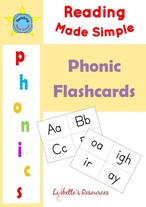
FREE Phonic Flashcards
All the flashcards required, from the alphabet through to the end of Level one.
|

A good ABC book like this one
|

A colourful way to check progress, and a handy reference chart for the child to help with letter/shape/sound recall.
|
Plentiful more FREE resources can be found on our sister site, Sound it out Phonics.
Initial Sounds Bumper Resource Pack $5 from TPT
This pack is not essential for teaching the Reading Made Simple programme, but it will help to bring your teaching alive!

This site and its contents are copyright J. Arrowsmith 2025
All rights reserved.
Free downloads are supplied subject to the terms and conditions which can be found here.
No part of the website or the contents of any free downloads can be copied either mechanically or electronically without permission from the site owner who can be contacted here.
All rights reserved.
Free downloads are supplied subject to the terms and conditions which can be found here.
No part of the website or the contents of any free downloads can be copied either mechanically or electronically without permission from the site owner who can be contacted here.
I am a participant in the Amazon Services LLC Associates Program, an affiliate advertising program designed to provide a means for me to earn fees by linking to Amazon.com and affiliated sites.
This costs the purchaser nothing extra.
In this way I can continue to provide free resources.
Thank you for your support.
This costs the purchaser nothing extra.
In this way I can continue to provide free resources.
Thank you for your support.
